
 info[at]tellostec.de
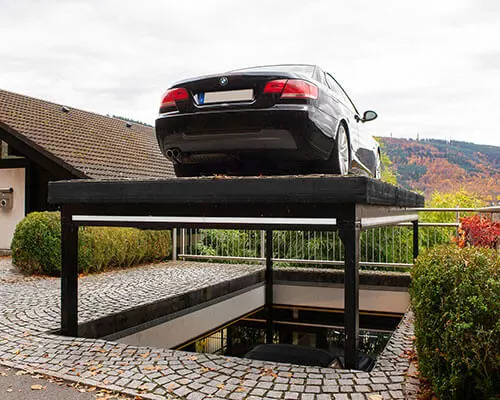
Parking lifts are one of the most innovative solutions in the field of parking management in urban areas and play an important role in reducing traffic and increasing parking capacity.
With growing urbanization and the increasing number of vehicles, the need for more efficient and effective parking solutions is becoming increasingly urgent.
In this article, a comprehensive study of the functioning of parking lifts and their positive impact on reducing traffic and increasing parking capacity is conducted.
Introduction
Living in big cities is associated with numerous challenges, one of the most important of which is the traffic problem and the lack of parking space.
With the increasing number of vehicles and limited urban spaces, finding a suitable parking space has become a major problem.
Parking lifts have found a suitable solution to this problem through the use of advanced technologies and intelligent designs.
History and development of parking lifts
Parking lifts were first introduced in recent decades as an innovative solution for parking space management.
Initially, these systems were simpler in design and could only accommodate a limited number of vehicles.
With time and advances in technology, parking lifts have evolved and are now able to support a larger number of vehicles and offer more advanced services.
Types of parking lifts
Parking lifts can be divided into different types, each with their own characteristics and advantages.
The most common types of parking lifts include
- Vertical parking lifts: This type of parking lift is designed vertically and is usually used in tall buildings and towers.
These systems take up less horizontal space and can accommodate many vehicles on different levels. - Horizontal parking lifts: These parking lifts are designed horizontally and are more commonly used in open spaces and large parking garages.
These systems can move vehicles horizontally and are normally used in multi-story parking garages. - Automated parking lifts: These systems are fully automated and use robots and intelligent control systems to park vehicles precisely and without human intervention.
This type of parking lift is often used in luxurious and ultra-modern environments.
Advantages of using parking lifts
Parking lifts offer numerous advantages, some of the most important of which are listed below:
- Space saving: Parking lifts are able to accommodate more vehicles in a smaller space due to their multi-layered and vertical design.
This is particularly useful in densely populated urban areas with limited horizontal space. - Traffic reduction: The use of parking lifts makes the parking and exit process quicker and easier.
This leads to a reduction in traffic on the roads and paths near parking lots, as vehicles spend less time looking for a parking space. - Increased safety: Parking lifts reduce the risks associated with manual parking through the use of automatic and controlled systems.
These systems can park vehicles precisely and error-free, which helps to reduce accidents and potential damage. - Energy efficiency: Parking lifts often use energy storage systems that minimize energy consumption.
These features make parking lifts a sustainable and environmentally friendly solution. - Ease of use: Parking lifts are very easy and convenient to use thanks to their intelligent design and advanced control systems.
Users can easily find their parking space and park their vehicle using smart maps or mobile apps.
Positive effects on urban traffic
One of the most important effects of parking lifts is the reduction in urban traffic.
The use of these systems significantly reduces the time it takes to find a parking space.
This helps to reduce traffic on the streets and roads near parking lots.
In addition, the shorter parking time reduces greenhouse gas emissions and air pollution, which has a positive impact on the environment.
Successful examples worldwide
Parking lifts have been used in many large cities around the world and have achieved positive results.
In Tokyo, one of the most densely populated cities in the world, the use of parking lifts has contributed significantly to reducing traffic and increasing parking capacity.
In European cities such as Berlin and London, these systems have also been well received and have achieved positive results.
Challenges and solutions
In addition to the benefits, there are also challenges associated with the use of parking lifts.
The initial installation and set-up costs of these systems can be high, but given the long-term savings in space and time, these costs are justified.
In addition, regular maintenance and repair of these systems requires careful and regular planning.
Some of the proposed solutions to these challenges are:
- Public and private investment: Financial support from governments and private companies can help reduce initial installation and set-up costs.
- Education and training of skilled workers: Training qualified and specialized workers to maintain and repair parking lifts can help improve the performance and extend the life of these systems.
- Use of modern technologies: The use of advanced and intelligent technologies in the design and construction of parking lifts can help improve efficiency and reduce operating costs.
Conclusion
Parking lifts offer a significant role in reducing traffic and increasing parking capacity in urban areas through intelligent and efficient solutions.
By using these systems, a significant improvement in the management of parking areas and the reduction of urban traffic problems can be observed.
In addition, parking lifts contribute to environmental protection and the creation of sustainable cities by reducing energy consumption and greenhouse gas emissions.

